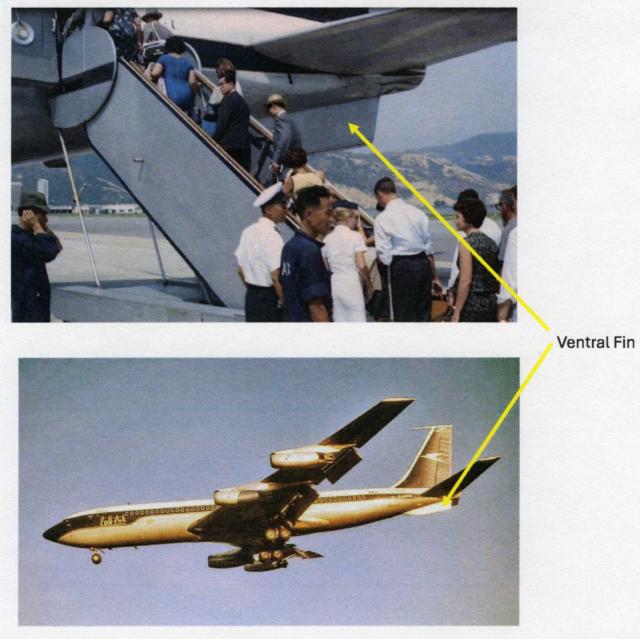
BOAC's B707s and VC 10s were the primary means of air transport between the UK and Hong Kong during the 1960s/70s. This changed when Cathy Pacific and British Caledonian were allowed to service the route in the early 1980s and bring in much needed competition.
The structural feature under the rear fuselage of early BOAC Boeing 707s was not a traditional fuselage bumper or tail skid, but a ventral fin (i.e. a stabilizing under-fin)
BOAC (British Overseas Airways Corporation) was the first airline to mandate this feature because the British Air Registration Board (ARB) refused to certify the Boeing 707 unless Boeing fixed severe aerodynamic and yaw stability issues.
During flight testing in the late 1950s, the ARB’s legendary Chief Test Pilot, David P. Davies, discovered critical handling flaws in the standard Boeing 707 layout. When BOAC ordered its custom variant—the Boeing 707-420 equipped with Rolls-Royce Conway engines—the British authorities demanded major design changes before it could legally carry passengers.
The issues they discovered, and why the ventral fin was the solution, include:
- Dangerous "Dutch Roll": The early 707 had poor lateral and directional stability. If hit by a gust of wind, it suffered from a violent, combined weaving and rolling motion. The ventral fin provided critical surface area under the tail to steady the plane.
- Engine-Out Controllability: In a "hot and high" take-off environment where one engine failed at low airspeed, the pilot didn't have enough rudder control to counter the asymmetric thrust. The ventral fin gave the tail more "bite" in the airflow to keep the aircraft straight.
- Over-Rotation Protection: Early 707s lacked sophisticated stall warnings and leading-edge wing slats. If a pilot pulled back on the yoke too aggressively during take-off, the aircraft could "over-rotate" into an unrecoverable ground stall. The ventral fin acted as a aerodynamic barrier, limiting how high the nose could pitch up.
- The Fix Became the Global Standard
- Because of BOAC's refusal to accept the aircraft without these safety changes, the introduction of the 707 into British service was delayed by five months. Boeing was forced to implement a comprehensive upgrade package:
- Extended the main tail fin upward by 40 inches.
- Installed full hydraulic rudder boost for giving extra control power to the pilot.
- Added the ventral fin under the rear fuselage.
Once Boeing saw how much these modifications improved safety and handling, they made them standard production features across almost all subsequent early model Boeing 707 variants worldwide.
(Note: On much later models like the 707-320B Advanced and 320C, the ventral fin was finally removed after Boeing upgraded the wings with advanced leading-edge flaps, lowering the required take-off pitch angle.)