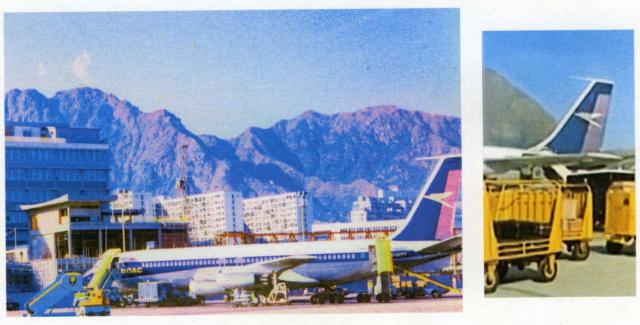
BOAC’s B707s and VC 10s were the primary means of air transport between the UK and Hong Kong during the 1960s/70s. This changed when Cathy Pacific and British Caledonian were allowed to service the route in the early 1980s and bring in much needed competition.
Looking at early 1960s colour images of BOAC B707s at Kai Tak, it was quite noticeable that some had pink/mauve coloured rudders. Initially I thought this was due to some sort of film processing or old film stock aberration. However, the real reason is somewhat stranger.
The distinctive mauve, pink, or purple tint seen on the rudders of BOAC Boeing 707s was not a decorative paint choice, but rather the natural appearance of raw, unpainted metal parts treated with protective anti-corrosion coatings.
Because the rudder is a primary flight control surface, its design required strict adherence to weight and aerodynamic balance limits. The following engineering factors caused this unique visual effect. Fabric or Zinc-Chromate Primers: Control surfaces like the 707's rudder were often left bare or coated with a translucent, protective chemical primer rather than heavy layers of standard livery paint. Depending on the specific batch of zinc-chromate primer, anodizing, or clear lacquers used over the aluminium, the metal surfaces naturally took on a yellowish-green, gold, or iridescent mauve/pink tone when under direct sunlight.
The "Bare Metal" Look: BOAC’s classic livery featured a polished, bare-metal lower fuselage and wing section. To prevent the moving rudder from sticking or suffering aerodynamic balance issues from the weight of heavy blue or white paint, it was left in its treated metallic state.
Lighting and Film Distortion: In vintage colour photography and film from the 1960s and 70s, the reflection of the blue sky against this anti-corrosion coating significantly distorted the colour, shifting it from a dull grey-metallic to a distinct shade of pinkish-purple or mauve.
The effect was later resolved, and subsequent aircraft appeared with “normal blue” rudder colours.