This range is similar in construction to the range at High West, with the stone wall protecting those working the targets. However, unlike the High West range, the steel brackets for the targets are still intact. Here's a picture that purports to show the firing point of this range, along with the claim that this was used mainly by police:

To get there, head upstream along the catchwater, which is easily accessible where it meets Quarry Bay Tree Walk near the BBQ site. It's on the right bank (i.e. on your left, if you're heading upstream) a bit short of where the concrete ends. A bit of advice: bring bug spray. Location shown clearly on the 1952 map.
I spent some time there today with my metal detector on the slope behind the range, and I've found two Mk. VII .303 metal-jacketed bullets, and a large number of unjacketed lead fragments and projectiles. Funnily enough I don't think I saw any of the .455 Webley bullets which were so common on the High West range.
Does anyone have any more information about this range? Who used it, when?
Photos that show this Place
Comments
Taikoo Firing Range
The photo is from the rear of the former upper Stanley Terrace (expat staff flats for Taikoo Dock, where I lived in the 1940s and 50s). Several of the Taikoo kids including me played around the rifle range from time to time, and I used to cross the adjacent nullah on my way to play weekly tennis at Woodside from the mid-50s.
The range was primarily used by the police when I lived there, but not very often.
I have recently received some additional info from a former US marine, John Wall, who has been researching USS Asheville, sunk in 1942. He notes from the deck log that while it was undergoing repairs at the HK Whampoa Kowloon Docks, a detachment of 37 marines went over to the Taikoo range 16 March 1923 for small arms firing.
In response to HongKonger's query, I suspect the range was more frequently and more widely used before WW II. But presumably not when the Taikoo Ropeway was in use!
Geoff Wellstead
Firing Platform
Thank you both for posting the photo and sharing the background information on this firing platform. I've always been interested in finding out where the actual firing point was located.
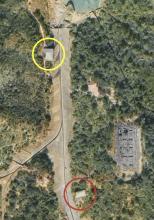
When I visited the area some years ago, I came across a flat-roofed, pavilion-like structure, shown in the photo below.
Based on a comparison with the 1963 colorized aerial photo from hkmaps.hk, it appears to be about 100 meters upstream from the original firing platform.
What caught my attention is that both structures share a very similar concrete-pillar design, which makes me wonder whether they were originally built as a pair of firing platforms.
The raised edge at one end of the platform also seems well suited to such a purpose.
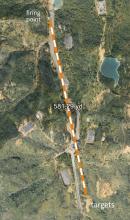
There may even have been additional firing platforms further upstream for shorter-range practice at that time, since the original firing point appears to have been over 500 yards from the upstream targets. Of course, this is only my guess, and the structure may well have served an entirely different purpose.
One thing that puzzles me, however, is why the target line was set at a slight angle rather than directly facing the firing points downstream.
Firing Range Target Site
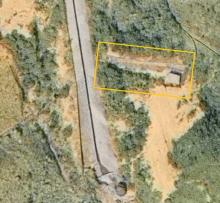
To reach the target site, follow the concrete-lined catchwater uphill until it transitions into a stone-paved catchwater channel near its upper end. A short distance to the left of the catchwater near this point are the remains of the firing range target site.
Here stands a long stone wall, with several rusted metal target frames lined up in a row behind it.
A closer look at one of the target frames, showing the hoisting mechanism and the brick step platform used for tending the targets.
Another view showing the remains of a pulley and steel wire lying on the ground.
A different view of the metal target frame, with the stone wall forming a backdrop behind it.
A concrete storehouse with a sloping roof stands at the far end of the compound.
Note the unusual door-within-a-door design, incorporating a small opening near the bottom. The purpose of this feature remains uncertain. Perhaps someone can help explain its function.
Looking through the open doorway into the interior of the storehouse.
A pair of surviving pulleys and their horizontal axle, used to hoist the target board, can be seen hanging near the top of this target frame adjacent to the storehouse.