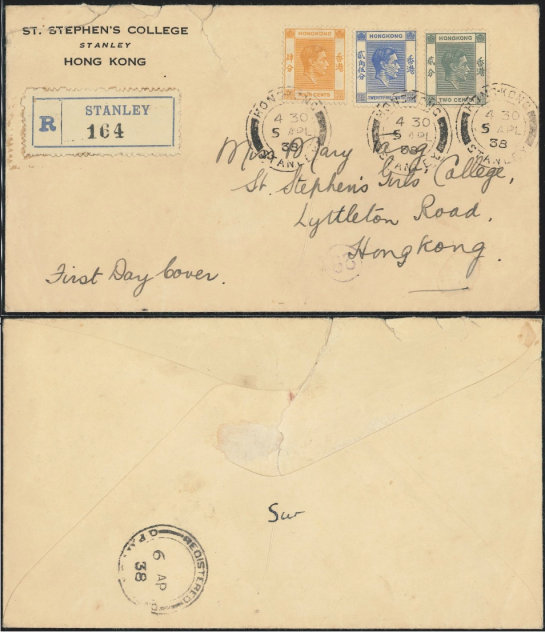
1938 (5 APL) St. Stephen’s College St. Stephen’s Girls’ College Stanley Post Office First Day Registered Cover - sent from ST. STEPHEN’S COLLEGE to Miss Mary Tang, St. Stephen’s Girls’ College, Lyttleton Road, Hong Kong
**Notice from St. Stephen's Girls' College, Hong Kong**
Since its establishment, our school has achieved outstanding educational success. Students recommended to sit for the entrance examinations of the University of Edinburgh in the UK have consistently achieved top marks, demonstrating the superior academic standard of our institution. Below are the admission details:
1. **English & Western Curriculum:** Taught by Western faculty, covering English Language, English Conversation, Composition, and Music. Special advanced courses are specifically designed to prepare students for the Higher and Lower Examinations of the University of Hong Kong. 2. **Chinese Curriculum:** Covers the Classics, History, Literature, Poetry, and Epistolary Writing, taught by distinguished Cantonese scholars and experienced faculty members. 3. **Boys' Prep Admissions:** Our school also admits boys aged 12 and under to prepare them for secondary school entry. 4. **Kindergarten Classes:** The English Kindergarten Class accepts all boys and girls aged 7 and under, teaching reading, writing, handcrafts, and related skills. A dedicated Chinese Kindergarten Class is also available for those focusing on Chinese studies. 5. **Term Commencement:** The current term begins on December 28 (Solar Calendar). 6. **Tuition Discount:** Students enrolling after the Lunar New Year will receive a 50% discount on tuition for this term. 7. **Prospectus:** For detailed prospectus and regulations, please visit the school at No. 27 Caine Road to collect a copy.
*9th day of the 11th Lunar Month, Yimao Year (1915)* **St. Stephen's Girls' College Council**
Subject: St. Stephen's Girls' College (聖士提反女子中學) – 1915 Admissions Notice & Caine Road Footprint
Context:
Hi Gwulo community,
I wanted to share a fascinating piece of primary source material from the 9th day of the 11th Lunar Month, Yimao Year (December 1915). It’s an admissions notice issued by the St. Stephen's Girls' College Council when the school was operating out of its early home. [1]
The text details that the school was operating at No. 27 Caine Road. Historically, we know they moved to this site around 1909 before the 1918 Shantou Earthquake damaged it, prompting their 1923 move to the current Lyttelton Road campus. [1, 2, 3, 4]
The notice gives a vivid window into daily operations back then:
Academic Tracks: They had an English/Western track preparing girls for the University of Hong Kong exams, but also a classical Chinese track run by local Cantonese scholars.
Global Pathways: It explicitly boasts about its students consistently scoring top marks in the University of Edinburgh entrance examinations, showing how globally connected Hong Kong's elite education was even during WWI.
Young Boys & Kindergarten: Interestingly, they admitted boys aged 12 and under for secondary prep, and ran both an English and a Chinese kindergarten track.
Term Date: The term was set to start on December 28, 1915, with a 50% tuition discount offered to anyone joining after the Lunar New Year. [, 2]
Context: The Elite Tier of Female Higher Education in 1915
St. Stephen's Girls' College was part of a highly exclusive group of institutions pioneering university preparation for young women in early colonial Hong Kong. At the time, the newly opened University of Hong Kong (HKU), founded in 1911, did not initially admit women, forcing elite students to look abroad to institutions like the University of Edinburgh. However, by the mid-1910s, pressure was mounting to open HKU's doors to local women. Alongside St. Stephen's, schools like Ying Wa Girls' School (英華女學校), run by the London Missionary Society, and Belilios Public School (庇理羅士女子中學)—the government’s flagship English school for girls—were the primary pipelines providing the rigorous English-medium curriculum required to sit for overseas matriculation and local university local exams. When HKU officially admitted its very first female undergraduates in 1921 (including pioneers like Rachel Irving and Lai Po-chuen), it was precisely these institutions, along with St. Stephen's, that provided the trailblazing candidates.
Subject: St. Stephen's Girls' College (聖士提反女子中學) – 1915 Admissions Notice, Caine Road Footprint, and Early Bilingual Kindergarten Tracks
Context:
Hi Gwulo community,
I wanted to share a fascinating piece of primary source material from the 9th day of the 11th Lunar Month, Yimao Year (December 1915). It’s an admissions notice issued by the St. Stephen's Girls' College Council when the school was operating out of its early home.
The text details that the school was operating at No. 27 Caine Road. Historically, we know they moved to this site around 1909 before the 1918 Shantou Earthquake severely structurally damaged the building, prompting their 1923 move to the current Lyttelton Road campus.
The notice gives a vivid window into daily operations back then:
Academic Tracks: They had an English/Western track preparing girls for the University of Hong Kong exams, but also a classical Chinese track run by local Cantonese scholars.
Global Pathways: It explicitly boasts about its students consistently scoring top marks in the University of Edinburgh entrance examinations, showing how globally connected Hong Kong's elite education was even during WWI.
Young Boys & Kindergarten Age Brackets: Interestingly, the school operated as a crucial early ladder for both genders. They admitted boys aged 12 and under for secondary school preparation. Furthermore, they offered two distinct kindergarten tracks accepting all boys and girls aged 7 and under.
Term Date: The term was set to start on December 28, 1915, with a 50% tuition discount offered to anyone joining after the Lunar New Year.
The Kindergarten Dual-Language Tracks
The breakdown of the kindergarten for children aged 7 and under is a fascinating early look at bilingual track division in early colonial Hong Kong:
The English Kindergarten Class: Taught entirely by Western faculty, this track focused on English literacy, conversation, and European progressive pedagogy like handcrafts. It was designed to give children of British, Eurasian, and elite Chinese families a head start in English immersion before entering premier secondary schools.
The Chinese Kindergarten Class: Taught by experienced local Cantonese scholars, this track focused on early Chinese character recognition, classical literature recitation, and basic brushwork. This catered to wealthy families who wanted a modernized structure but were fiercely protective of their cultural heritage and traditional business networks.
This brief announcement carries immense weight for the history of women's education and colonial academic systems in Hong Kong:
The Institution (聖士提反女書院): This refers to St. Stephen's Girls' College, founded in 1906 by the Church Missionary Society (CMS). In 1915, providing advanced Western-style secondary education to Chinese women was highly progressive, making this centralized achievement a monumental victory for early female empowerment in the colony.
The Exam (柯士佛大學之試): "柯士佛" is the early 20th-century Cantonese transliteration for Oxford (University of Oxford). Before Hong Kong developed its own localized matriculation system, elite colonial schools sat for the prestigious Oxford Local Examinations (administered directly from the UK).
The Telegram from London (英京來電): The phrase "昨得接英京來電" (yesterday a telegram was received from the British Capital) highlights the global colonial logistics of the era. Exam papers were shipped by sea to England for grading, and the thrilling news of their success ("皆獲列榜" - all passed and made the honors list) was wired back to Hong Kong via undersea telegraph cables.
This snippet beautifully illustrates the global academic pipeline connecting early Hong Kong female scholars directly to the highest institutions of the British Empire.
Comments
Dec., 1915
**Notice from St. Stephen's Girls' College, Hong Kong**
**Notice from St. Stephen's Girls' College, Hong Kong**
Since its establishment, our school has achieved outstanding educational success. Students recommended to sit for the entrance examinations of the University of Edinburgh in the UK have consistently achieved top marks, demonstrating the superior academic standard of our institution. Below are the admission details:
1. **English & Western Curriculum:** Taught by Western faculty, covering English Language, English Conversation, Composition, and Music. Special advanced courses are specifically designed to prepare students for the Higher and Lower Examinations of the University of Hong Kong.
2. **Chinese Curriculum:** Covers the Classics, History, Literature, Poetry, and Epistolary Writing, taught by distinguished Cantonese scholars and experienced faculty members.
3. **Boys' Prep Admissions:** Our school also admits boys aged 12 and under to prepare them for secondary school entry.
4. **Kindergarten Classes:** The English Kindergarten Class accepts all boys and girls aged 7 and under, teaching reading, writing, handcrafts, and related skills. A dedicated Chinese Kindergarten Class is also available for those focusing on Chinese studies.
5. **Term Commencement:** The current term begins on December 28 (Solar Calendar).
6. **Tuition Discount:** Students enrolling after the Lunar New Year will receive a 50% discount on tuition for this term.
7. **Prospectus:** For detailed prospectus and regulations, please visit the school at No. 27 Caine Road to collect a copy.
*9th day of the 11th Lunar Month, Yimao Year (1915)*
**St. Stephen's Girls' College Council**
St. Stephen's Girls' College (聖士提反女子中學) – 1915 Admissions Notice
Subject: St. Stephen's Girls' College (聖士提反女子中學) – 1915 Admissions Notice & Caine Road Footprint
Context:
Hi Gwulo community,
I wanted to share a fascinating piece of primary source material from the 9th day of the 11th Lunar Month, Yimao Year (December 1915). It’s an admissions notice issued by the St. Stephen's Girls' College Council when the school was operating out of its early home. [1]
The text details that the school was operating at No. 27 Caine Road. Historically, we know they moved to this site around 1909 before the 1918 Shantou Earthquake damaged it, prompting their 1923 move to the current Lyttelton Road campus. [1, 2, 3, 4]
The notice gives a vivid window into daily operations back then:
Context: The Elite Tier of Female Higher Education in 1915
St. Stephen's Girls' College was part of a highly exclusive group of institutions pioneering university preparation for young women in early colonial Hong Kong. At the time, the newly opened University of Hong Kong (HKU), founded in 1911, did not initially admit women, forcing elite students to look abroad to institutions like the University of Edinburgh. However, by the mid-1910s, pressure was mounting to open HKU's doors to local women. Alongside St. Stephen's, schools like Ying Wa Girls' School (英華女學校), run by the London Missionary Society, and Belilios Public School (庇理羅士女子中學)—the government’s flagship English school for girls—were the primary pipelines providing the rigorous English-medium curriculum required to sit for overseas matriculation and local university local exams. When HKU officially admitted its very first female undergraduates in 1921 (including pioneers like Rachel Irving and Lai Po-chuen), it was precisely these institutions, along with St. Stephen's, that provided the trailblazing candidates.
Early Bilingual Kindergarten
Subject: St. Stephen's Girls' College (聖士提反女子中學) – 1915 Admissions Notice, Caine Road Footprint, and Early Bilingual Kindergarten Tracks
Context:
Hi Gwulo community,
I wanted to share a fascinating piece of primary source material from the 9th day of the 11th Lunar Month, Yimao Year (December 1915). It’s an admissions notice issued by the St. Stephen's Girls' College Council when the school was operating out of its early home.
The text details that the school was operating at No. 27 Caine Road. Historically, we know they moved to this site around 1909 before the 1918 Shantou Earthquake severely structurally damaged the building, prompting their 1923 move to the current Lyttelton Road campus.
The notice gives a vivid window into daily operations back then:
The Kindergarten Dual-Language Tracks
The breakdown of the kindergarten for children aged 7 and under is a fascinating early look at bilingual track division in early colonial Hong Kong:
香港華字日報, 1915-10-13
Historical Analysis & Context